The Cloud Concentration Trap: Your Bank Is Only as Resilient as Its Shared Vendors
Zeeshan Mallick · 2026-09-11
Financial firms can be resilient alone yet fragile together when banks and fintechs share critical cloud, identity, network, and payment vendors.

A bank can have a strong disaster plan and still fail because its most important supplier fails first.
Key Insight
Financial firms spend heavily on cybersecurity, backup systems, recovery teams, and internal controls. That work matters. But it can create a false sense of safety when many firms depend on the same cloud, software, identity, network, and data providers.
A bank may be resilient on its own. The sector may still be fragile together.
This is the cloud concentration trap: the hidden risk created when many important financial services share a small group of critical vendors. One disruption can become many outages. One software change can become a market event. One supplier’s recovery time can become a bank’s customer problem.
The controversial question for 2026 is not “Is our cloud provider secure?” It is:
How many financial firms fail if the same provider is unavailable?
The regulators are testing the shared failure
The Bank of England defines operational resilience as the ability of firms and the financial sector to prevent, adapt to, respond to, recover from, and learn from disruptions.[1]
The definition is deliberately wider than an IT department. The Bank includes cyberattacks, IT outages, third-party supplier failure, fire, flood, severe weather, and pandemics. It says disruption can affect a firm’s safety and soundness, policyholder protection, and, in some cases, financial stability.[1]
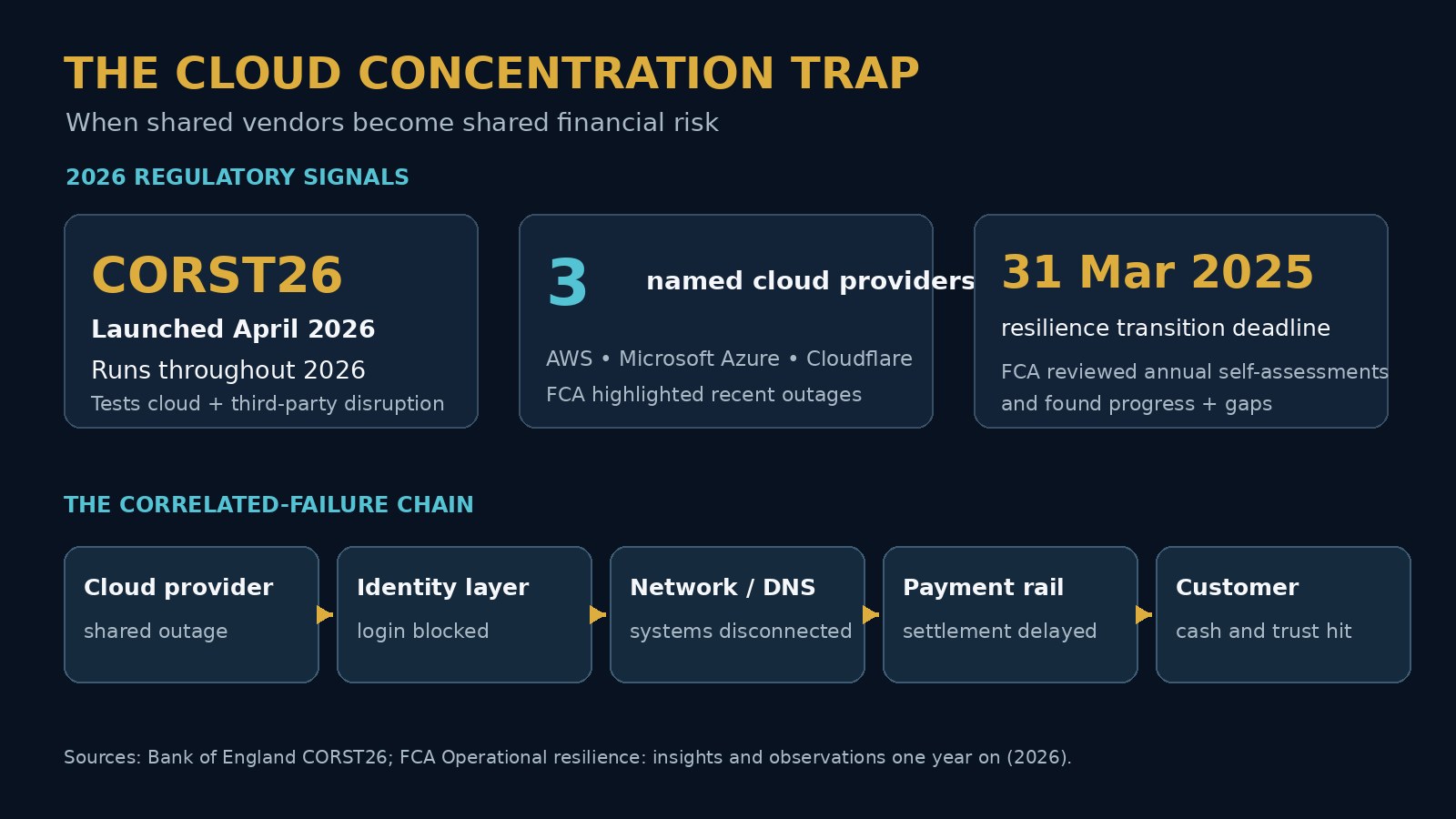
The Bank’s 2026 test makes the concern concrete. CORST26 launched in April 2026, runs throughout 2026, and explores a cloud service provider and third-party disruption scenario aligned to SIMEX26.[2] The results will go to the Financial Policy Committee, with thematic findings planned for summer 2027.[2]
| Regulatory signal | What it means for management |
|---|---|
| CORST26 tests cloud and third-party disruption | Shared-vendor failure is a financial-stability issue, not only an IT issue |
| The test runs throughout 2026 | Resilience must be tested under changing conditions, not once |
| Findings go to the Financial Policy Committee | Operational failure can have macroprudential relevance |
| The FCA introduced clearer incident and third-party reporting in 2026 | Vendor events now require stronger supervisory visibility |
The outage is not the only risk
The obvious scenario is a cloud outage. A provider becomes unavailable and customers cannot log in, send payments, price assets, or access records.
The harder scenarios are less dramatic. A faulty software update affects authentication. A regional network problem delays settlement. A cyberattack forces a provider to isolate systems. A data inconsistency causes firms to stop processing. A recovery environment exists but cannot handle peak volume.
| Failure mode | Immediate effect | Hidden second-order effect |
|---|---|---|
| Cloud region outage | Applications become unavailable | Several institutions lose the same service path |
| Identity-provider failure | Customers cannot authenticate | Fraud controls may block legitimate access |
| Network or DNS disruption | Systems cannot connect | Payment and market deadlines are missed |
| Software release error | Incorrect or unstable processing | Multiple firms repeat the same defect |
| Data corruption | Records cannot be trusted | Firms pause activity until reconciliation is complete |
| Provider cyber isolation | Service is deliberately restricted | Recovery may depend on the same provider |
The risk is not simply downtime. It is correlated downtime.
What the FCA saw after the 2025 deadline
The FCA’s March 2026 review examined firms’ annual operational-resilience self-assessments after the transition period ended on 31 March 2025.[3] The FCA reports strong engagement and good progress across the requirements, but it also points to recent high-profile outages involving cloud service providers such as Amazon Web Services, Microsoft Azure, and Cloudflare.[3]
The FCA says those events were severe but plausible scenarios that firms should include in their testing. It also reports that firms have invested in data vaulting, immutable backups, standby data centres, and new processing centres to help recover important business services within impact tolerances.[3]
That is progress. It is not proof of independence.
A standby data centre that still depends on the same identity provider, network, software vendor, or cloud control plane may be a second building—not a second operating capability.
The resilience theatre problem
A firm can present a strong resilience score by showing that it has a backup. But a backup is useful only if it can operate independently under stress.
The board should ask whether the backup uses a different cloud, different region, different credentials, different network route, different software deployment path, and different supplier support chain. If the answer is no, the firm may have redundancy on paper but concentration in practice.
| Question | Weak answer | Stronger answer |
|---|---|---|
| Can we fail over? | “We have a second environment.” | “We tested a live failover at peak volume.” |
| Is the backup independent? | “It is in another availability zone.” | “It has a separate provider and control path.” |
| Can we operate without the vendor? | “The contract has an exit clause.” | “We can run critical services during a timed exit.” |
| Can customers still transact? | “We will communicate.” | “We have a tested minimum service.” |
| Can we reconcile later? | “Data is replicated.” | “We have immutable records and a reconciliation drill.” |
The strongest evidence is not a policy document. It is a successful test with real dependencies and real limits.
Why CFOs and fintech operators should care
For a CFO, a shared-vendor outage can create lost revenue, delayed payroll, missed settlement, customer compensation, liquidity pressure, and emergency financing needs. It can also create accounting uncertainty if transaction records cannot be reconciled quickly.
For a fintech operator, the most important vendor may not be the obvious one. The chain can include cloud infrastructure, database services, payment processors, card networks, identity providers, fraud tools, email delivery, DNS, observability, and customer-support platforms.
For HNWIs and family offices, the risk appears as delayed transfers, blocked access, missing valuations, or an inability to confirm whether an instruction was completed. A service may be technically “up” while the customer’s critical action remains impossible.
Operational resilience is therefore a financial issue. It affects cash conversion, liquidity, client trust, and the ability to complete a transaction at the moment it matters.
What management should measure
Do not measure resilience only in uptime percentages. Uptime can look excellent while a high-impact function fails for the customers who need it most.
Track the time to detect, time to decide, time to switch, time to restore, and time to reconcile. Track the percentage of critical services that depend on the same provider, region, identity system, network, and data path. Track the number of services that can operate in a degraded mode and the number that require the original vendor to recover.
| Metric | Why it matters |
|---|---|
| Maximum tolerable disruption | Defines the real business boundary |
| Recovery time achieved in testing | Shows whether plans work under pressure |
| Recovery point and reconciliation time | Shows whether records can be trusted after failure |
| Shared-provider dependency percentage | Reveals correlated exposure |
| Critical services with tested exit paths | Measures practical independence |
| Manual fallback capacity | Shows how long the firm can operate without automation |
A resilience metric without a failure scenario is usually a comfort metric.
The vendor contract is not the recovery plan
Contracts can require reporting, service levels, audit rights, and cooperation. They cannot guarantee that a provider will recover before a bank’s impact tolerance expires.
A serious contract should define incident notification, data access, forensic cooperation, testing rights, subcontractor visibility, exit support, portability, deletion evidence, and recovery responsibilities. It should also identify what happens if the provider itself is under attack or unable to support every customer at once.
The firm must still own the plan. Outsourcing a service does not outsource the consequence of failure.
Conclusion
The FCA’s 2026 observations show that firms are investing in stronger backups, standby centres, and processing capability.[3] The Bank of England’s CORST26 shows that cloud and third-party disruption is being tested as a sector-level problem, not merely a technology problem.[2]
The controversial truth is that resilience spending can increase concentration if every firm buys the same solution from the same small group of vendors.
The next board question should be direct:
If our primary cloud, identity, network, or payment provider disappears for 24 hours, what can we still do—and who else disappears with us?
FAQ
What is cloud concentration risk in finance?
It is the risk that many financial firms rely on the same cloud or technology providers, so one disruption can affect multiple institutions and services at the same time.
Is cloud computing unsafe for banks and fintechs?
No. Cloud services can improve scale, security, and recovery. The risk comes from common dependencies, weak exit plans, and untested assumptions about independence.
What is CORST26?
CORST26 is the Bank of England’s 2026 Cyber and Operational Resilience Stress Test. It explores a cloud service provider and third-party disruption scenario and runs throughout 2026.[2]
What did the FCA report in March 2026?
The FCA reviewed firms’ annual resilience self-assessments, noted strong progress, highlighted recent cloud-provider outages, and said firms had invested in data vaulting, immutable backups, standby data centres, and new processing centres.[3]
What should a CFO ask a cloud provider?
Ask which services share infrastructure, how failover works, how data is exported, how long an exit takes, what happens during a provider-wide incident, and whether the firm can operate a minimum service without the provider.
Is a second cloud region enough?
Not necessarily. A second region may still share the same provider, identity layer, network controls, software release, or support chain. Independence must be tested, not assumed.
Is this investment advice?
No. This is a general analysis of operational resilience, third-party dependency, cloud concentration, and financial infrastructure. Companies and individuals should obtain appropriate legal, compliance, accounting, and regulated financial advice for their own circumstances.
Sources
[1] Bank of England, “Operational resilience of the financial sector,” 21 July 2026
[2] Bank of England, “Cyber and Operational Resilience Stress Test (CORST),” 3 July 2026
[3] FCA, “Operational resilience: insights and observations one year on,” 27 March 2026